2026: Volume 57
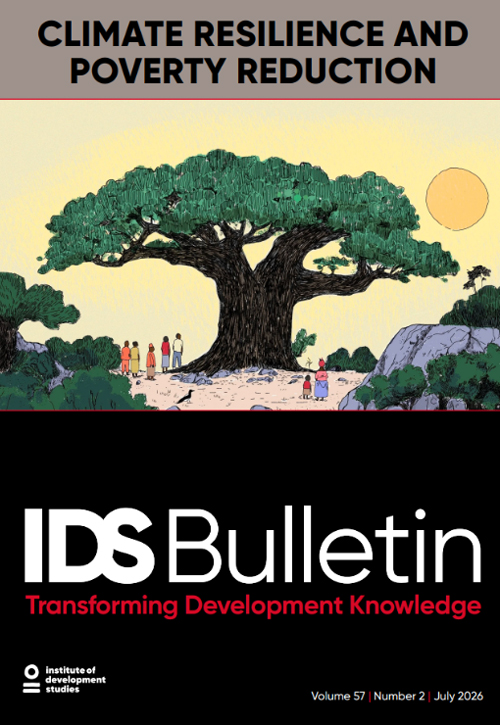
Volume 57 Number 2 July 2026
Edited by: Vidya Diwakar and Brian Mulenga
East and Southern Africa face a disproportionately high burden from climate change, which is posing a growing threat to poverty reduction in these regions. Given the dependence of poor and vulnerable rural populations on agricultural livelihoods, support programmes and policies urgently need to address weather shocks. However, the level of welfare or wellbeing at which these climate shocks can be resisted is often underestimated.
The research topics identified in this issue of the IDS Bulletin raise important questions for policy making and programme design: which policies, programmes, and investments will most effectively reduce the climate resilience threshold?
The articles in this IDS Bulletin highlight the mechanisms through which climate change drives negative poverty dynamics. They examine the role of adaptation and instruments in mitigating these negative impacts and identify policy pathways for building long‑term resilience to both poverty and climate change. The articles here provide entry points into what action might look like, for individuals, households, communities, nations, and international systems.
The evidence presented in this issue integrates consideration of different types of instruments, such as social protection, vocational training, and livelihood systems support, and considers the extent to which these are fit-for-purpose, and politically feasible, in order to address structural issues. There is also a clear argument that current climate finance is often not poverty focused, requiring a shift towards gender-sensitive, poverty-targeted, locally led programmes.
By consolidating this evidence, this issue of the IDS Bulletin aims to inform national and international policymakers, practitioners, and researchers seeking to design effective, context‑specific strategies that safeguard livelihoods in an era of increasing climate uncertainty.
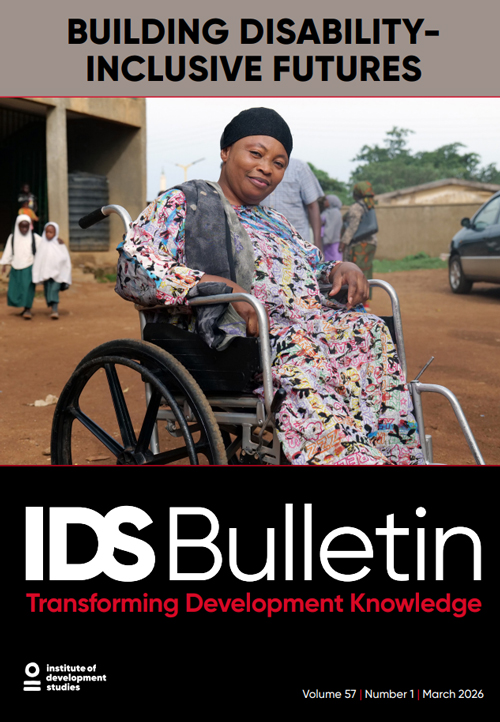
Volume 57 Number 1 March 2026
Edited by: Stephen Thompson, Brigitte Rohwerder, Claire Walsh and Gayatri Sekar
Whilst significant progress has been made in recent years with regard to ensuring that development interventions are more inclusive, people with disabilities still remain underrepresented in development programmes and research. The landmark adoption of the UN Convention on the Rights of Persons with Disabilities (CRPD) in 2006 changed how disability is considered within society, as well as within the development sector. But there is still so much to do before all interventions are meaningfully inclusive of people with disabilities.
This issue of the IDS Bulletin presents a collection of articles written by researchers and practitioners involved in the UK aid-funded Disability Inclusive Development (DID) programme. In particular, the articles include a focus on three broad themes: strengthening the evidence base; cross-cutting issues relevant to disability-inclusive development; and the central role of Organisations of Persons with Disabilities (OPDs).
Drawing together key insights and lessons across the DID programme, the articles explore a range of topics relating to disability and development such as health, education, safeguarding, transport, stigma, the most marginalised groups, the imperative role of OPDs, and disability-inclusive approaches to research and evaluations.
This is the first IDS Bulletin issue in its long history to have an explicit focus on disability.
The editorial team are very proud of this thematic focus, believing that disability must be mainstreamed within development discourse, programming, and research if no one is to be left behind. We are also pleased to say, this IDS Bulletin is produced in an accessible format that goes beyond the expectations linked to current publishing legislation.
2025: Volume 56

Volume 56 Number 2 November 2025
Edited by: John Gaventa, Rosie McGee and Alex Shankland
A critical issue of our time is how the world can transition from a development model based on the extraction and use of fossil fuels to one based on cleaner sources of energy, and how it does so in a just and inclusive way.
Central to this issue of the IDS Bulletin is the recognition that to be just, any transition must include consideration of the voices, knowledges, and realities of communities most affected. By bringing together authors from both the global South and the global North, covering a wide range of communities affected by different dimensions of the energy transition, we find long histories of action and resistance developed around encounters with earlier transitions.
The articles in this IDS Bulletin highlight cases of advocacy being used to strengthen community voices to make the processes of consultation more inclusive and empowering of marginalised perspectives. In doing so they also address a less well documented citizen-led pathway that focuses on bottom-up forms of action through grass-roots innovation and social movements.
Given the multiple historical forms of injustice which surround energy production, struggles for just transition must ultimately involve multiple forms of justice – be they distributive, recognitional, procedural, restorative, or reparative.

Volume 56 Number 1 August 2025
Edited by: Shandana Khan Mohmand and Marjoke Oosterom
What has shifted us towards a more autocratic, rather than democratic, world?
While there is nothing new about a politically divided citizenry, the current state of democracy strongly calls for an analysis of the diverse motivations of citizens to vote for leaders and parties that have promised outright they would undo democratic institutions.
The articles in this issue of the IDS Bulletin look at how people engage with democracy – their basis for voting for certain leaders. The authors discuss the ideas and narratives that underlie the expectations citizens have of what these leaders would deliver in terms of redistribution to enhance the welfare and the recognition of their rights as the voting citizens, at the repudiation of the rights of others.
Democracy works where checks and balances through political, institutional, and social accountability institutions work. In liberal democracies, the judiciary is the first line of defence, but when autocrats come to power, they swiftly move to undermine an independent judiciary, concentrate powers in the hands of the executive, and constrain the media and other important freedoms. The contributions in this IDS Bulletin highlight how this has unfolded in the US, India, the Philippines, Brazil, and across parts of Africa and Europe. In turn, they also provide insights into what can be done to halt and reverse these dynamics and address feelings of discontent by those who feel left behind by a lack of redistribution. How can left-wing and other political parties that aim to uphold inclusive democratic values reconnect with the constituencies they lost to parties with autocratic tendencies?

Volume 56 Number 1A February 2025
Edited by: Melissa Leach and Ian Scoones
The establishment of the IDS Environment Group in 1990 created a line of research linked to policy that has remained central to the Institute ever since. In highlighting a series of IDS Bulletin issues, led by IDS researchers, this archive issue tracks the development of this work over the last 35 years. It also tells a broader story of the contribution of IDS to key debates on environment and development evolving over this time. During these decades environmental challenges have become ever more acute, with environmental questions being absolutely central to Development and Development Studies in a world of multiple intersecting crises.
So, what then have been the core contributions of this body of work emerging from IDS and partners over the past decades? Some of the themes highlighted by the IDS Bulletins featured here include: key contributions tracking debates over the relationships between environment, development and policy in the early 1990s; the emerging emphases on social dimensions, communities, resources and livelihoods, including work linking environmental research with long-standing gender research at IDS; the politics of environmental knowledge, exploring local knowledges and perspectives and the ways these challenge mainstream science and policy; and uncertain knowledges and the development of the ‘pathways approach’ to sustainability, bringing together understandings of complex, dynamic systems.
Over the years all this has combined with analyses of power and political economy, highlighting of questions of justice, both around the causes and consequences of environmental change and the processes of transformation towards more sustainable futures. All of these themes remain relevant to critical policy-oriented research on environment and development emerging from IDS and beyond that we hope will continue to shape global debates on these most crucial issues of our time.